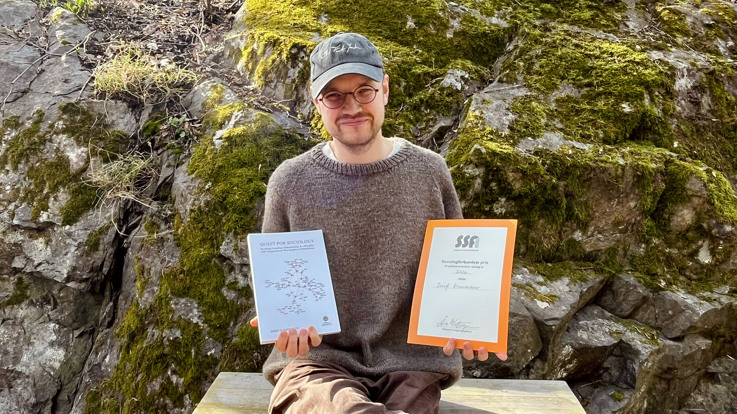
The thesis, Quest for Sociology: Revisiting Prevailing Understandings of a Discipline with Computational Text Analyses of Dissertations, was written at Uppsala University and examines the development, identity and potential fragmentation of sociology through advanced text analyses of Swedish doctoral theses from 1980 to 2019. The findings suggest, among other things, that sociology has evolved towards increasing specialisation rather than fragmentation.
In its statement, the jury highlights the thesis as an independent and highly original contribution to the understanding of sociology’s identity and its potential crisis. With an ambitious and carefully designed research framework – in which entire theses are analysed using advanced text-analytical methods – the study provides a nuanced picture of how the sociological landscape has changed over time and differs across academic environments. The work is described as a bold and reflexive project that both challenges previous research and lays a solid foundation for continued discussion on the development of sociology.
When sociology was institutionalised in Sweden, the discipline was long shaped by a narrow positivist ideal that excluded qualitative and theoretical traditions, placing today’s methodological debates in a historical perspective.
“During my doctoral studies, somewhat ironically, several sociologists who had established themselves through this historically ‘forbidden’ research felt the need to point out that my theory-driven large-scale text analyses were, in fact, not sociology. Against that background, I see the award as a modest recognition of computational social science within general sociology – and as an appeal to senior scholars not to extinguish the curiosity and drive of junior researchers, even if they do not always understand what fuels it,” says Josef Ginnerskov.





