
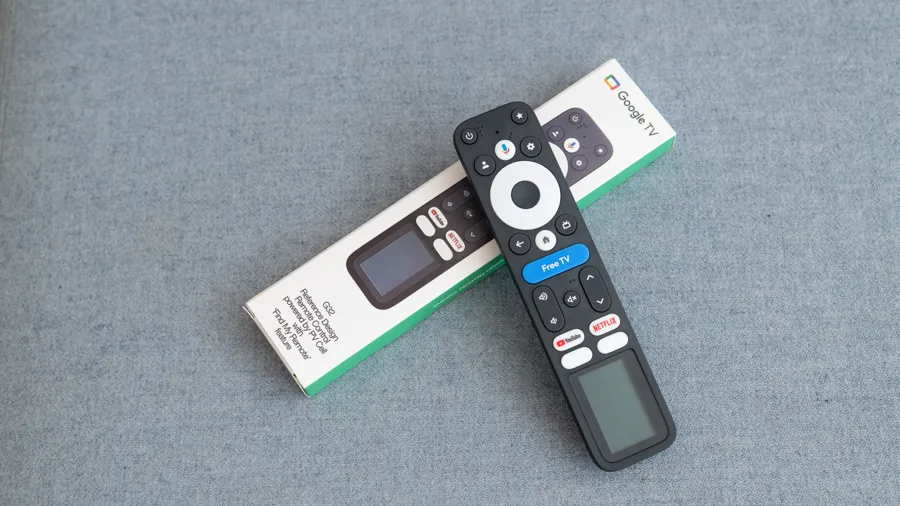
The agreement with Google TV means that Epishine’s solar cells will soon be used in remote controls for millions of smart TVs and TV boxes worldwide.
“Fantastic breakthrough”
“It’s a fantastic breakthrough,” says Mattias Josephson, Chief Strategy Officer of Epishine, when we meet him at the company’s office in Linköping.
The process used to print solar cells is very similar to printing a newspaper. A plastic film runs on rolls through machines that print different electronic properties onto it. The finished solar cells are thin, flexible and can be produced in many different sizes and shapes.
“Our process is unique in terms of scalability and cost-effectiveness, and the new materials we use are also environmentally friendly,” says Mattias Josephson.
Indoor light powers the Google TV remote control
 Magnus Johansson
The solar cells are optimised to absorb light from indoor lighting and convert it into energy. This means that the remote control for the new Google TV will, in many cases, never need to be charged in any other way. However, the option is there if the television is positioned in a very dark location or if the remote control is used extremely frequently.
Mattias Josephson shows the display shelf with the company’s products. Alongside the Google TV remote control and other remotes are items such as electronic shelf-edge labels.
“Retailers have started to adopt our idea. In a large store, there may be 50,000 labels with batteries that need replacing. It’s far more suitable to power them with solar cells instead,” says Mattias Josephson.
Other applications include sensors that measure factors such as humidity and temperature in buildings, and devices to track the location of goods, a process known as asset tracking.
Pioneer in organic solar cells
Epishine has its roots in Olle Inganäs’s laboratory at Linköping University. He is professor emeritus of biomolecular and organic electronics and one of the pioneers in organic solar cells.
 THOR BALKHED
“It was in the 1990s that I began working more intensively on it. I wanted to develop a scalable technology with as little material and energy input as possible,” he says.
At that time, it was still too expensive to manufacture solar cells from silicon for large-scale production to be economically viable. He therefore focused his research on organic materials. He established collaborations with chemists and emphasises that developing new technology requires expertise from many different fields.
The efficiency of organic solar cells, that is, how efficiently energy is converted, increased steadily. In the early 2010s, it surpassed 10 per cent. Today, it has reached 22 per cent and is beginning to approach the efficiency of traditional solar cells.
“I wouldn’t have believed that was possible with organic materials. It’s nice to be wrong when it’s in the right direction,” says Olle Inganäs.
Founded Epishine
During his career, he has spun several research ideas into companies and wanted to do the same with the large-scale roll-to-roll production of solar cells. He and several of the researchers in his group were in contact with the university’s innovation office, LiU Innovation. Through that connection they got to know Mattias Josephson, an entrepreneur who had recently sold a company and was looking to get involved in a new venture. In the summer of 2016 they founded Epishine together.
 Magnus Johansson
“So this summer we celebrate our tenth anniversary. And I dare say that today we are world-leading when it comes to printing solar cells,” says Mattias Josephson.
Epishine continues to collaborate closely with doctoral students and researchers at LiU. Olle Inganäs has remained involved in the company’s development, although not on a daily basis. Today his focus is on developing materials for future energy storage using batteries based on raw materials from the sea and forests.
From batteries to self-powered electronics
Mattias Josephson is optimistic about the future for Epishine. The agreement with Google TV is important in several ways.
“Our business concept is to produce large volumes. Those who buy large volumes are big customers and big customers are cautious. When Google TV chooses to buy from a small Swedish newcomer, others start thinking that they can do the same.”
He continues:
“The world needs to move on from toxic single-use batteries to self-powered electronics, both for environmental reasons and because the number of batteries that would need replacing would be completely unrealistic. The Internet of Things is moving towards an internet of trillions of things. Our products meet a major need there.”
Translation: Simon Phillips





