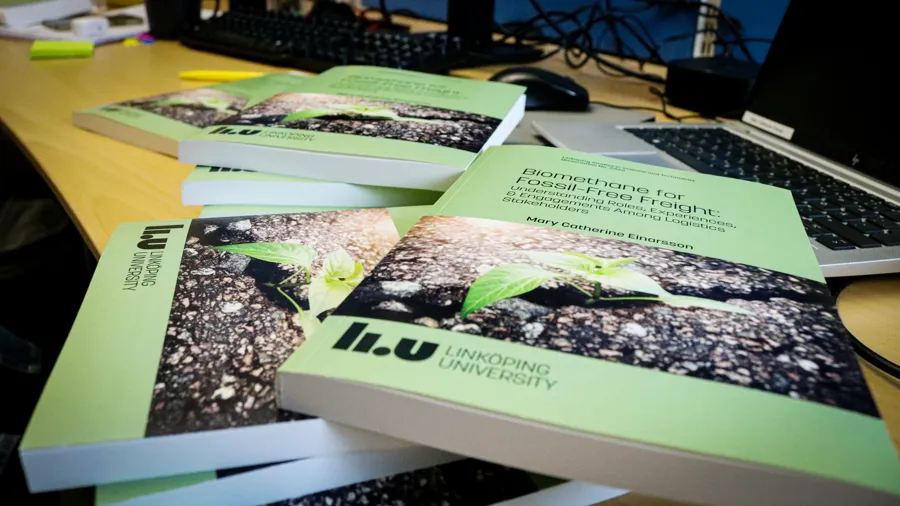
In her doctoral thesis, Mary Catherine Einarsson examines the transition to biofuels with a particular focus on biogas in road freight transport. Road transport accounts for a significant share of greenhouse gas emissions.
“A common assumption is that once the technology is in place, the transition will happen by itself. In reality, it is more complex. Starting to use biogas affects whole networks of actors that are involved in freight transport in different ways.”
For Sweden and the EU to meet their climate targets, a rapid move away from fossil fuels is required. One solution that is already in operation is biogas, also known as biomethane. It is produced locally from organic waste from sources such as households and agriculture. When used as a vehicle fuel, it can replace fossil fuels like diesel in heavy goods vehicles, leading to lower carbon dioxide emissions.
Road freight logistics involve haulage companies, transport buyers, freight forwarders and public actors such as politicians and energy companies. Together they form a network in which responsibility, power and influence are distributed in different ways. Mary Catherine has studied how these actors collaborate and interact.
“When a new fossil free fuel such as biogas is introduced, these relationships change. Who takes the initiative, who pays and who carries the risk?”
Politics
Political decisions can have a major impact. One example is when the tax exemption for biogas in Sweden was removed and later reinstated.
“This caused uncertainty among actors about stability. It shows that political decisions can have both rapid and long lasting effects on the expansion of a biofuel such as biogas.”
Mary Catherine Einarsson notes that the transition to biogas requires collaboration. The thesis identifies different ways in which logistics actors work together, ranging from close partnerships to more passive forms of participation. There are also differences in how sensitive different actors are.
“For example, transport buyers and freight forwarders may work together to develop new offerings based on biogas transport, while haulage companies often adapt to requirements imposed higher up the chain. A better understanding of roles, drivers and barriers makes it easier to anticipate how different actors will respond to new sustainability initiatives.”
Collaboration and engagement
A key finding in the thesis is that organisational culture is often more important than economic factors when companies transition to biogas. Previous research frequently highlights costs as the main barrier to green transport. Here, a different picture emerges.
“Companies that clearly prioritise sustainability and encourage employees to try new solutions find it much easier to introduce biogas into their transport operations. Committed managers, long term thinking and a willingness to be a frontrunner play a major role.”
Costs and practical challenges do exist, but they are perceived as manageable when internal motivation is strong.
“In one of my examples, a freight forwarding company chose to support a haulage company by purchasing biogas vehicles. This enabled the haulage company to take on the work and also resulted in the use of sustainable fuels.”
Technology is not everything
The transition to fossil free transport is largely a social and organisational process. It is the interaction between actors, cultures and policy conditions that determines how quickly and effectively change takes place.
This insight can be valuable for companies that want to reduce their emissions.
“They would be wise to look not only at vehicles and prices, but also at relationships, collaboration and internal values. Long term and stable policy instruments are needed to give actors the confidence to invest. Biogas may not be the most talked about solution in the climate transition, but when used and organised in the right way, it can play an important role on the path towards fossil free freight transport,” says Mary Catherine Einarsson.