
According to the researchers from Linköping University behind the study, few within the field believed it would be possible. The reason is that the atoms in perovskite materials should, in theory, interact so strongly that the qubit would collapse before the calculation could be completed. However, the experiments conducted by the Linköping team show that it works.
“Our findings open up an entirely new research field,” says Yuttapoom Puttisong, associate professor at Linköping University. Olov Planthaber
The researchers hope that this new research field will eventually contribute to the construction of a functional quantum computer capable of performing advanced calculations that today’s traditional supercomputers cannot manage.
Superposition
A quantum computer operates using quantum bits, or qubits, to process information. They can be compared to ones and zeros in a traditional computer. What sets them apart is that a qubit does not need to be in one state or the other; instead, it can exist in all states between one and zero. This is known as superposition. As a result, far more information can be handled in a smaller space.
There are many different ways to create a qubit. The most common technique at present is superconducting qubits, used by IBM, Google and others in their attempts to build a quantum computer. However, they are extremely sensitive and operate only at temperatures mere thousandths of a degree above absolute zero. Achieving such cooling requires significant energy and space, making the technology difficult to scale.
Spin qubit
Another type of qubit is based on the so-called spin of electrons in a material. These qubits are created using defects in solid materials – extremely precise alterations in the material’s structure. The most common defect used to create a “spin qubit” is diamond, in which two carbon atoms have been replaced by a nitrogen atom. However, it is a process that is highly energy-intensive, expensive and technically demanding.
“That is why we began exploring a new idea – to ‘cook up’ our qubits in the lab,” says Yuttapoom Puttisong.
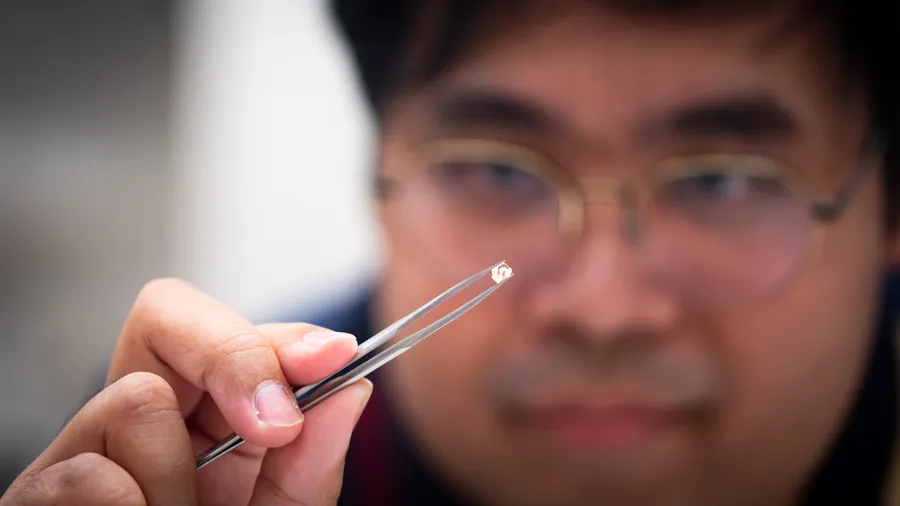 Olov Planthaber
“The great advantage is that we can do this quickly, cheaply and, above all, in a controllable way. We can design the qubit’s properties through the chemistry of the solution,” says Yuttapoom Puttisong.
Large potential
Furthermore, the technique can operate at higher temperatures than absolute zero, which opens the possibility of scaling it up. The researchers have also demonstrated that the signals from the qubit can be translated into optical signals, enabling quantum communication using light in perovskite-based materials.
“There is significant potential in the technology. It is possible to tailor the material chemically to achieve the properties we want. In the long term, I believe it could become a natural part of our society in the same way that silicon is today,” says Sakarn Khamkaeo, doctoral student at Linköping University.
The study was funded by the Swedish Research Council, the Knut and Alice Wallenberg Foundation, the Swedish Energy Agency and through the Swedish Government’s Strategic Research Area in Advanced Functional Materials (AFM) at Linköping University.
Article: , Sakarn Khamkaeo, Kunpot Mopoung, Kingshuk Mukhuti, Maarten W. de Dreu, Anna Dávid, Muyi Zhang, Mats Fahlman, Feng Gao, Peter C. M. Christianen, Irina A. Buyanova, Weimin M. Chen, Yuttapoom Puttisong. Nature Communications 17, Article number: 415 (2026), published online 8 January 2026. DOI: 10.1038/s41467-025-67980-2
 Olov Planthaber





