
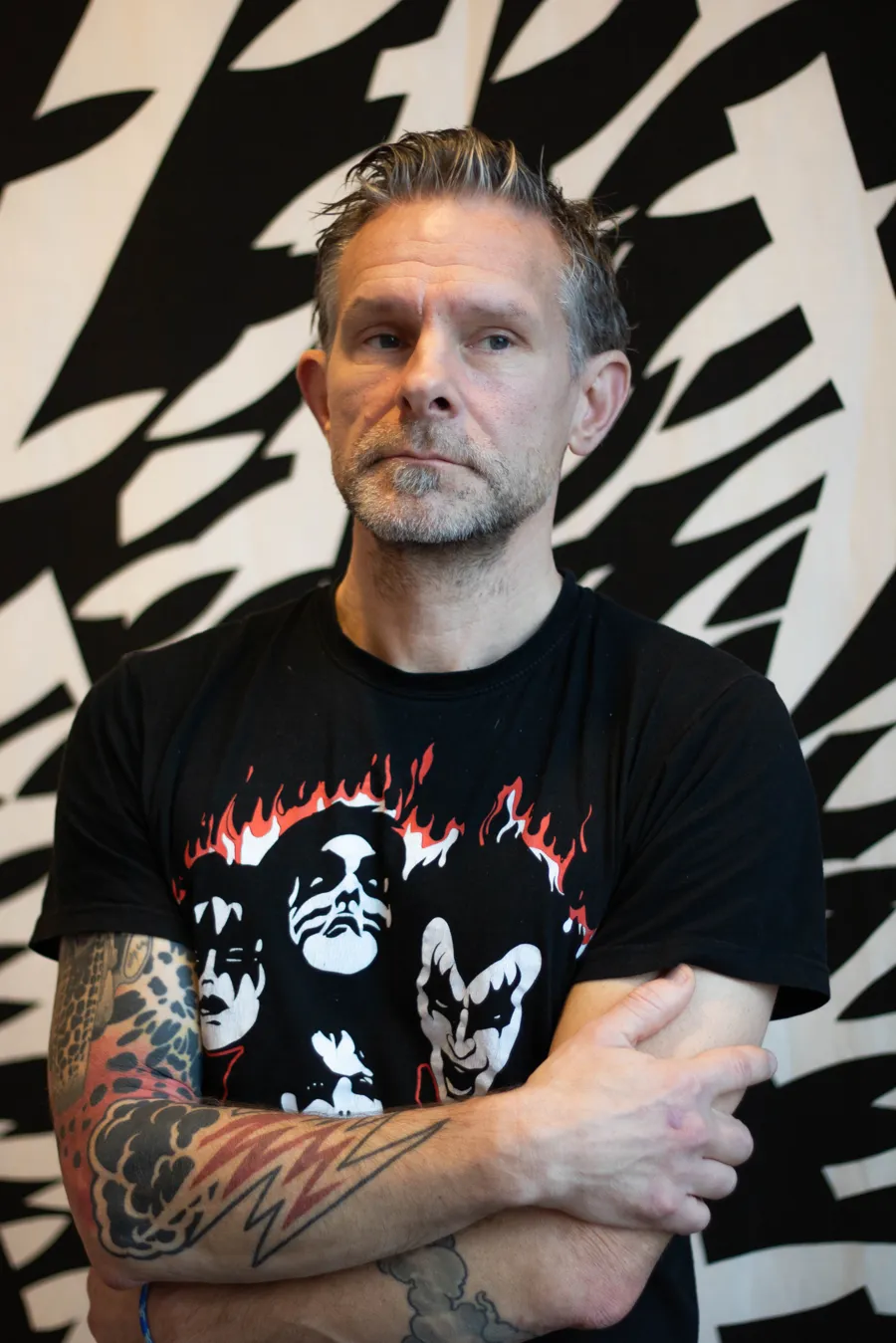
Magnus Dahlstedt is a professor at Linköping University. He researches access to, claims to and erosion of social rights, with a particular interest in migration and integration issues. In addition to doing what is expected of him at a university, he diligently disseminates his research in other contexts. He is a professor with a personal style who often comes back to why and how he writes the way he does.
In one of his columns in the journal Curie, he describes a meeting with a group of Year 1 pupils. The seven-year-olds stared at him in silence, thinking that “he doesn’t look like a professor, he has neither a white beard nor glasses.”
Children are honest, is this something that also occurs in public? Among adults?
“I’m pretty used to people having preconceptions when they meet me and think: ‘He’s one of those.’ A stereotypical researcher may be expected to dress and behave formally. But I don't care, this prejudice is embarrassing mainly for those who have it.”
Behind the scenes at a conference where he was to speak, the MC asked: “Are you the sound guy?” “No, I’ll be talking in a while, but as you mention it, I’m also looking for the sound guy,” Magnus replied.
Grew up in a working-class home
A white beard is not the only thing missing to match the image of an iconic professor; he also lacks an academic family background. In his family, the norm is to finish school and start working. Despite this, he ended up at university, where he eventually cracked the code and graduated.
“I love hard rock and I turned being nerdy into a scientific methodology. I started studying the same way as when I learned about genres, singers, band members, who wrote what or how long a particular guitar solo is. Ace Frehley of Kiss is my role model and actually one of the reasons I became a professor.”
He has a recurring nightmare. A scene from his thesis defence plays out in different variations, but with the same ending: the opponent tears him apart, he fails, packs up and goes out the back door…
“This tells me something, namely that I, a working-class boy from the outskirts of Falun, managed to become a professor. I have tried different ways to move forward and over the years I have realised that this nightmare isn’t true, I may have a place here after all. My background has become a driving force, I want my research to make a difference.”
Scientists need to learn to reach out with their knowledge
 Karin Midner
But before the book is printed, many readings and revisions are required. In his writing process, Magnus can rely on support from colleagues and others in his broad network, as he has many connections outside the university world.
“I accept all invitations! What happens outside of academia may not earn any points, and I sometimes get angry thinking about how little time there is for such work. This is academic duplicity. We researchers are expected to be seen and heard, communicate widely and spread knowledge – without being given the proper conditions. Unintelligible and locked-in knowledge is not very worthwhile. Everyone should be able to access research and understand it.”
He emphasises that all researchers need to be visible outside academia, not just doing what counts in a CV according to the metrics.
“We need to learn how to reach out with our knowledge. We need to be concise, quick and daring! Speak in a school, to politicians or on TV. How to disseminate research in different formats should be always included in doctoral education!”
It is also important to have fun as a researcher and, for Magnus, fun equals challenge. He believes that unchallenging research easily becomes repetitive and then it is no longer research.
“Academia is a machine where publications are to spread knowledge. I’m a small cog in this machine. I throw a spanner in the works and write things other than what earns points, because it fills a supporting function in society. Today, there is no room in the system for promoting democratic educational discussions.”
Susanna Alakoski paved the way
One person who helped shape Magnus' desire to explore writing in new ways is Susanna Alakoski. She was LiU’s visiting professor in the name of Moa Martinson from 2021 to 2023. She made him realise that writing differently was not that easy. Her writing exercises made him start writing regularly, every day.
 Karin Midner
“It’s quite rare that people express criticism, but silence is also a form of criticism.”
He admits that in some situations he may feel that he is saying the “wrong” things, which makes him wonder whether he should stop himself mid-sentence.
“But I keep going. What I have prepared to say, I say – no matter where I am. I understand that not everyone dares do this. Who wants to risk unease? We are living in troubled times, but I don’t care too much about it, I’m a bit of a nihilist that sense.”





