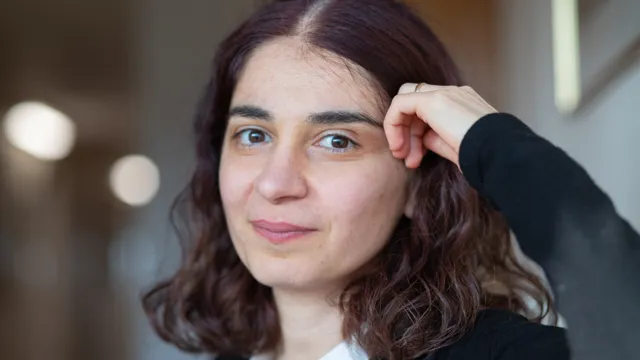
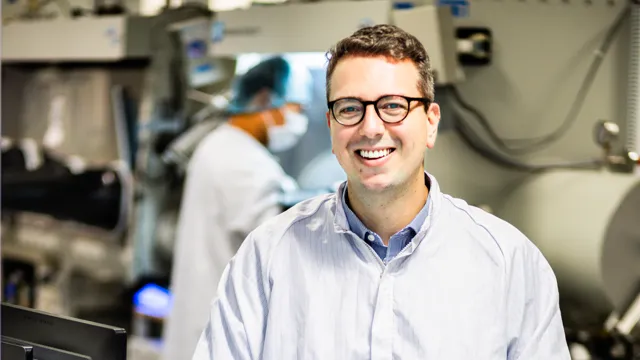
Max Karlsson's thesis has been honoured with both Svenska fysikersamfundet’s Oseen Medal 2024 for the best Swedish thesis in physics presented in 2023, and the IEEE
Identifying the complex dynamic processes of perovskites
Max's thesis, titled "Dynamics in blue emitting metal halide perovskites for light emitting diodes," focused on metal halide perovskites. This group of materials has garnered significant attention in recent years due to its simplicity in manufacturing and promising properties for optoelectronic applications, such as solar cells and LEDs. However, developing efficient and stable blue LEDs has remained a challenge. Dr. Karlsson's thesis sheds light on important factors affecting the material's stability and light efficiency, thereby enhancing understanding of its potential applications.
"Manufacturing blue LEDs, which are essential for both lighting and colour displays, has once again proven to be very tricky, making it a bit more exciting as well. Blue LEDs based on metal halide perovskites were, when I started (and to a large extent still are), both relatively inefficient and unstable, especially compared to commercial counterparts made from other materials," Max Karlsson explains.
Dr. Karlsson describes that his research not only identified the complex dynamic processes affecting the performance of perovskites, but also proposed possible solutions to enhance their usability. By exploring the behaviour of materials during the manufacturing and usage processes, he has contributed to increasing knowledge about the properties of perovskites and how they can be optimised for various applications.
Pedagogical and innovative
IEEE justifies Max Karlsson’s award by stating that his thesis is pedagogical and innovative in a way that paves the way for further research in the design and optimisation of perovskite-based devices. In addition to showcasing Max's in-depth knowledge of the subject, the prize committee hopes that Max's thesis will serve as a good example for other doctoral students who are in the midst of or starting their thesis writing process.
Max Karlsson describes the writing process of his thesis as a learning process in itself - a time when he tried to balance his role as a new father with long working hours and occasional questioning of what he was actually spending time on. Bouncing ideas and texts off his colleagues felt incredibly rewarding and sometimes unreasonably extensive, but in hindsight, it is something he believes is reflected in the quality of the thesis.
Just get going!
Dr. Karlsson's advice to other doctoral students is simple yet powerful - to just get started with writing, whether feeling inspired or not. He emphasises the importance of finding a level of satisfaction with the text and realising one's own expertise in the subject.
During his doctoral studies, Dr. Max Karlsson was part of the Electronic and photonic materials division at IFM, Linköping University, and his research studies were supervised by Professor Feng Gao.
Max will be awarded the Oseen Medal during the Lise Meitnerdagarna this autumn. The prize consists of a medal, diploma, and a cash award of SEK 100,000. The 2023 IEEE Best PhD Thesis Award consists of a diploma and SEK 10,000.