Many took it hard
In their article, Navigating disruptive crises through service-led growth: The impact of COVID-19 on Italian manufacturing firms, LiU professor Christian Kowalkowski and four Italian researchers investigate how the corona pandemic has affected Italian companies. They describe also the expectations the companies have for the future.
177 companies of different sizes from several industries have responded to a questionnaire, which has subsequently been supplemented with interviews with decision-makers. The study was carried out from the middle of March to the middle of April, when Italy was more or less completely shut down.
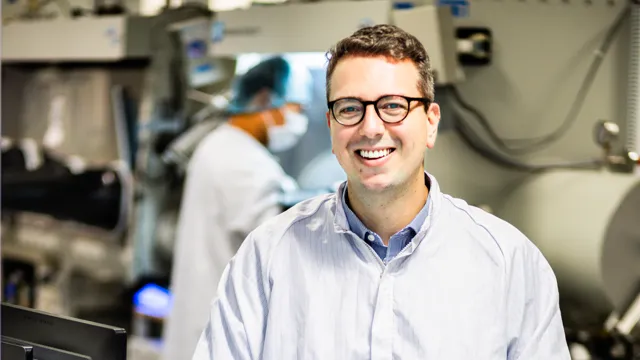
Christian Kowalkowski during the interview.
“The effects on the companies have been massive, and many of the interviewees have taken it hard. They find it difficult to talk about it. But at the same time, many people emphasise positive aspects of the crisis: that it was possible to realign rapidly, that people helped each other to find new solutions”, says Christian Kowalkowski.
Can the results be transferred to Swedish conditions?
“Not all of them, but a lot can be applied here. The shutdown has not been as extensive in Sweden, but we must remember that the crisis is far from over. The fundamentals are the same, even though the details and extent can differ between countries.”
Operations less affected
The study shows that service operations have been affected considerably less than manufacturing. 66% of companies stated that the effect on sales of products has been high or very high, to be compared with 49% for service and sales of other services. Only 6% stated that the effect on sales of goods had been none or limited, to be compared with 24% for service operations.
Earlier crises have also shown clearly that service-related operations cope more easily. In the aftermath of the financial crisis, for example, sales of Scania trucks fell by 40% in 2009, while the company’s service operations were essentially unaffected. The more advanced and digital the services are, the less will be the effects of a crisis.
“In a crisis, customers tend to postpone investment in new goods, while continuing to service the ones they already have. In this way, providing services can act as a parachute when sales of products falls”, says Christian Kowalkowski.
The researchers have seen how the Italian companies are passing through, and will continue to pass through, four phases during the corona crisis (illustrated below). Phases 1 and 2 are the first, acute emergency; Phase 3, which is where Italy is at the moment, deals with restarting the economy. Phase 4 is the future, the “next normal”, and how the companies can adapt to it most effectively.
Shift-work in Italy
Various characteristics are coupled to the phases, each one of which is particularly important during a certain period. In Phase 1, good preparedness is needed, while in Phase 2 agility is more important, with a focus on simple, rapid solutions. Phase 3 requires elasticity in order to restart operations. Some of the expressions of this elasticity in Italy have been the use of shift-work to spread employees’ attendance throughout the day, testing of personnel, and changes to the design of the workplace to ensure larger physical distances. Everything to reduce the risks.
Christian Kowalkowski points out that we have not yet entered Phase 4, but when we do it will involve building the robustness to face new emergencies. With his colleagues, he believes that the long-term trends towards digitalisation and servitisation will be reinforced and accelerated. Another trend for which we see a lot of evidence is a reduction in globalisation, as companies are compelled to move warehousing and manufacturing closer to markets.
Christian Kowalkowski poses the rhetorical question whether it is truly sensible, for example, that such a large fraction of the global production of pharmaceuticals and protective clothing and equipment is located in China, the country that was hit first by the pandemic.
“Regionalisation is not just about geopolitics, but also about effects on individual companies. Here, I believe that additive manufacture, 3D printing, can provide a major impetus to more regional production”, he says.
Contracts with insurance
Service production will also probably change, with less on-site service and more digital services provided remotely. It is also possible that completely new solutions that take the risk of new crises into account will be found, such as contracts adapted to the COVID-19 era with integral insurance. Work in itself will also change, with more work done remotely, new tools, and combinations of traditional work and work in the home.
One thing is certain: a lot will have to change, and the corona crisis does not solely bring problems and difficulties.
“The crisis offers huge opportunities for many companies. Those who can exploit these will emerge stronger from the crisis”, says Christian Kowalkowski.
Read the whole article here:
Translated by George Farrants
Four phases during the crisis
Graphic illustration.